If you are researching schools in the Portland metro area, you have likely come across the term dual language school alongside Spanish immersion, two-way immersion, and bilingual education. These terms are often used interchangeably online, but they describe meaningfully different models. Understanding the difference helps families choose the program that best matches their goals.
This guide explains what a dual language school is, how it compares to one-way Spanish immersion, what outcomes parents can expect, and how Spanish Horizons Academy in Hillsboro, Oregon fits within this landscape.
What Is a Dual Language School?
A dual language school is one where two languages are used to deliver the standard academic curriculum — not just as a class subject, but as the medium of instruction for math, science, social studies, and literacy. Students do not study a second language for forty-five minutes a day; they learn through it across the entire school week.
There are two main dual-language models:
- One-way immersion (also called dual-language immersion): The student body is primarily made up of native English speakers learning the target language — in our case, Spanish. The full academic day is split between Spanish and English instruction, with the majority delivered in Spanish in the early grades. This is the model used at Spanish Horizons Academy with its 80/20 split.
- Two-way immersion: The classroom is roughly half native English speakers and half native Spanish speakers, and both groups learn in both languages. Students serve as language models for one another, and the program is designed to produce balanced bilingualism in both populations.
Both models share the same core commitment: significant academic time in two languages, with the explicit goal of producing children who are fully bilingual, biliterate, and biculturally aware.
Dual Language vs. Spanish Immersion — What's the Difference?
In practice, "dual language" and "Spanish immersion" describe overlapping but not identical programs. The clearest way to think about it:
- A Spanish immersion school is one where Spanish is the primary medium of instruction. Children are surrounded by Spanish through academic content, with a smaller block of English literacy.
- A dual language school is the broader umbrella term that includes one-way immersion (Spanish-dominant, which is itself a form of immersion) and two-way immersion (balanced English/Spanish classrooms).
If you are choosing between programs, the questions that matter more than the label are:
- What percentage of the day is each language used?
- Does the school require prior Spanish for enrollment?
- What evidence does the school have that its graduates reach genuine bilingual fluency?
- Is there strong support for English Language Arts as well as Spanish literacy?
Spanish Horizons Academy uses an 80/20 immersion model. Roughly 80% of the school day is in Spanish, with 20% dedicated to English Language Arts. The program is open to families with no prior Spanish — children acquire the language through daily academic immersion rather than as a separate subject.
What Outcomes Can Parents Expect?
Research on dual-language education is remarkably consistent. The most cited longitudinal study — Thomas and Collier (2002) — followed more than 200,000 students across multiple districts and found that children in well-implemented dual-language programs:
- Match or exceed their monolingual peers on standardized tests in English by middle school.
- Develop genuine bilingual fluency, including the ability to read complex texts and write academically in both languages.
- Show stronger executive function — working memory, attention control, and cognitive flexibility — than monolingual children of the same age.
- Build deep cultural competence that translates into stronger long-term outcomes in college and the workplace.
The key qualifier in that research is "well-implemented." Outcomes depend on:
- Hours of exposure. Programs that dedicate 50%+ of instructional time to the target language consistently produce stronger fluency than those that don't.
- Teacher quality. Fluent, trained immersion teachers are the single largest variable.
- Program continuity. Children who stay in dual-language programs from kindergarten through fifth grade reach the strongest outcomes; sporadic exposure does not.
Spanish Horizons Academy is built around all three: an 80% Spanish day, native and near-native Spanish-speaking teachers, and a K-5 program designed for continuity from the first day of kindergarten through the end of elementary school.
Is a Dual Language School Right for My Family?
A dual language school is a strong fit if:
- You want your child to graduate elementary school with real, working Spanish — not phrases, but the ability to think, read, and communicate.
- You value cultural fluency alongside language fluency.
- You can commit to the program for multiple years, since immersion outcomes compound with time.
- You are comfortable with the early adjustment period that comes with hearing instruction in a new language.
It may be less of a fit if you are looking for short-term exposure or weekly enrichment. After-school Spanish classes and summer camps have value, but they cannot deliver the hours of exposure that produce true bilingualism.
Why Families Choose Spanish Horizons Academy
Spanish Horizons Academy is a K-5 Spanish immersion school in Hillsboro, Oregon, serving families from Hillsboro, Beaverton, Portland, and the surrounding metro. The program combines:
- 80/20 immersion model — significant Spanish exposure with consistent English literacy support.
- No prior Spanish required — the program is designed for children new to the language.
- Small classes of 12-16 students — individualized attention and active engagement.
- Expeditionary Learning methodology — project-based, hands-on academics conducted in Spanish.
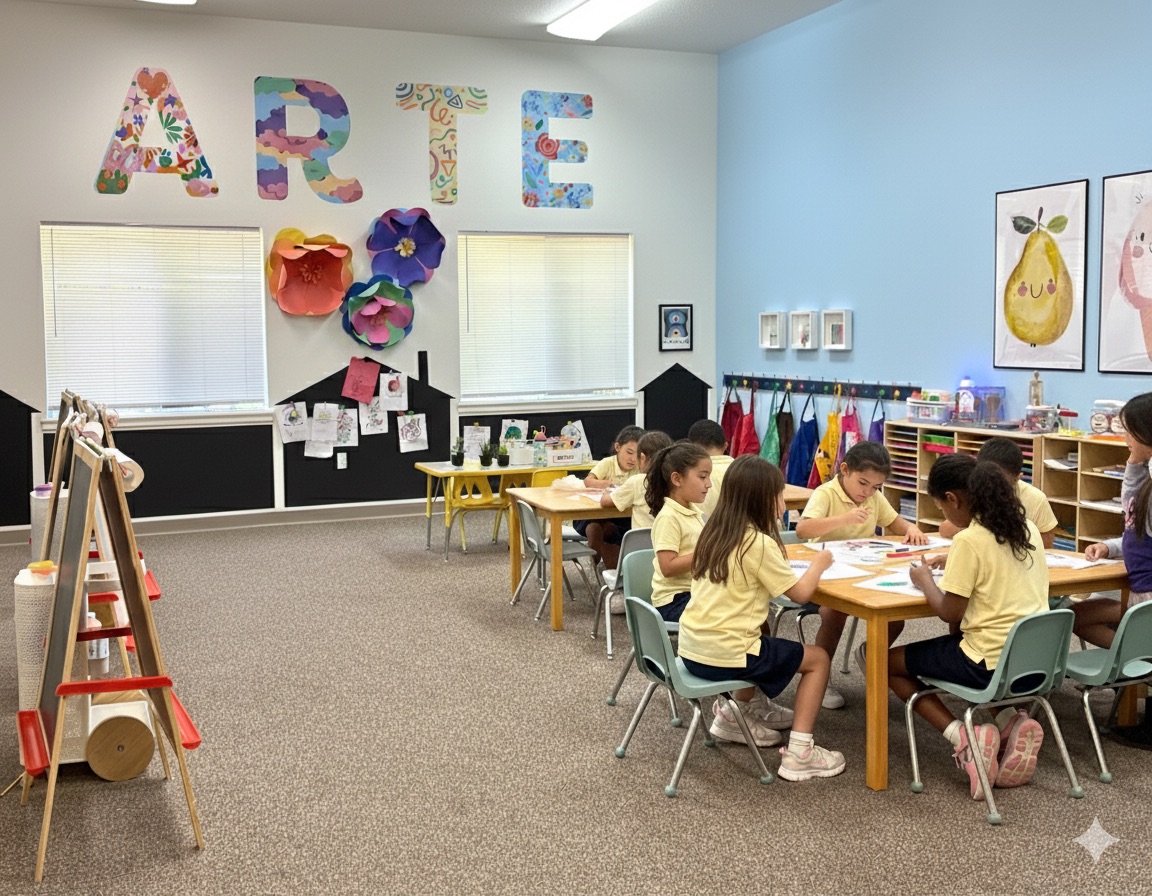
- Cultural enrichment — cooking, music, art, and traditions from Spanish-speaking cultures woven into daily learning.
The school was founded by Laura Paz-Whitmore as part of the Casita Azul family of schools, bringing years of bilingual education expertise to Hillsboro.
For families weighing dual-language options, the most useful next step is to see it firsthand. A tour shows what 80% Spanish actually looks like in a real classroom — and how children who started kindergarten knowing no Spanish are reading, writing, and conversing in it just a few years later.