
Imagine your child learning math, science, art, and social studies — all in Spanish. Picture them raising their hand to answer a question about fractions, not in English, but in fluent, confident Spanish. That is exactly what happens every day inside a Spanish immersion school. And for thousands of families across the United States, this model of education is becoming the gold standard for raising bilingual, academically strong, culturally aware children.
A Spanish immersion school is a school where the standard academic curriculum — the same subjects your child would learn anywhere else — is delivered primarily in Spanish. Students do not simply take a Spanish class once a day. They spend the majority of their school day learning grade-level content through the target language. The result is something remarkable: children who can read, write, think, and communicate in two languages by the time they finish elementary school.
If you are a parent exploring immersion education for the first time, you probably have questions. How does it actually work? What if my child does not speak any Spanish? Will they fall behind in English? This guide covers everything you need to know — how Spanish immersion schools operate, what the research says, what a typical day looks like, and how to decide if this path is right for your family. Research shows that children in immersion programs perform at or above grade level in both languages by third through fifth grade, and the cognitive benefits extend far beyond language itself.
How Does Spanish Immersion Education Work?
At its core, Spanish immersion education is built on a simple but powerful principle: children learn language best when they use it to learn something else. Rather than memorizing vocabulary lists or conjugating verbs in isolation, students in an immersion school acquire Spanish naturally — by listening to their teacher explain how plants grow, by solving word problems in math, by reading stories about historical figures, and by discussing scientific observations with their classmates. This approach is known as content-based instruction, and decades of research in second language acquisition confirm that it produces far stronger language outcomes than traditional methods.
Spanish immersion schools use different models depending on how they divide instructional time between Spanish and English:
- 90/10 Model: In the early grades, 90% of instruction is delivered in Spanish and 10% in English. The English percentage gradually increases each year until it reaches a more even split by fourth or fifth grade. This model provides maximum early exposure to the target language.
- 80/20 Model: Approximately 80% of the school day is taught in Spanish, with 20% reserved for English Language Arts. This is the model used by Spanish Horizons Academy in Hillsboro, Oregon, and it strikes a balance between deep Spanish immersion and consistent English literacy development from the very start.
- 50/50 Model: Instructional time is split evenly between Spanish and English. While this model still produces bilingual outcomes, the reduced exposure to Spanish means it typically takes longer for students to reach the same level of fluency as those in 80/20 or 90/10 programs.
You may also hear the terms one-way immersion and two-way immersion. In a one-way immersion program, the student body is primarily made up of native English speakers learning Spanish. In a two-way immersion program (also called dual-language immersion), the classroom includes roughly equal numbers of native English speakers and native Spanish speakers, and both groups learn in both languages. Both models are effective, and the best choice depends on your family's goals and the options available in your area.
The critical difference between a Spanish immersion school and a traditional "Spanish class" comes down to hours of exposure. A typical elementary Spanish class might offer one to three hours of instruction per week. An immersion school provides 25 to 30 hours per week of meaningful, academic engagement in Spanish. That difference in volume is what makes immersion so effective at producing genuine bilingual fluency.
What Does a Typical Day Look Like?
Parents often wonder what their child's school day actually looks like inside an immersion classroom. While every school structures its schedule slightly differently, the general rhythm is consistent across most programs.
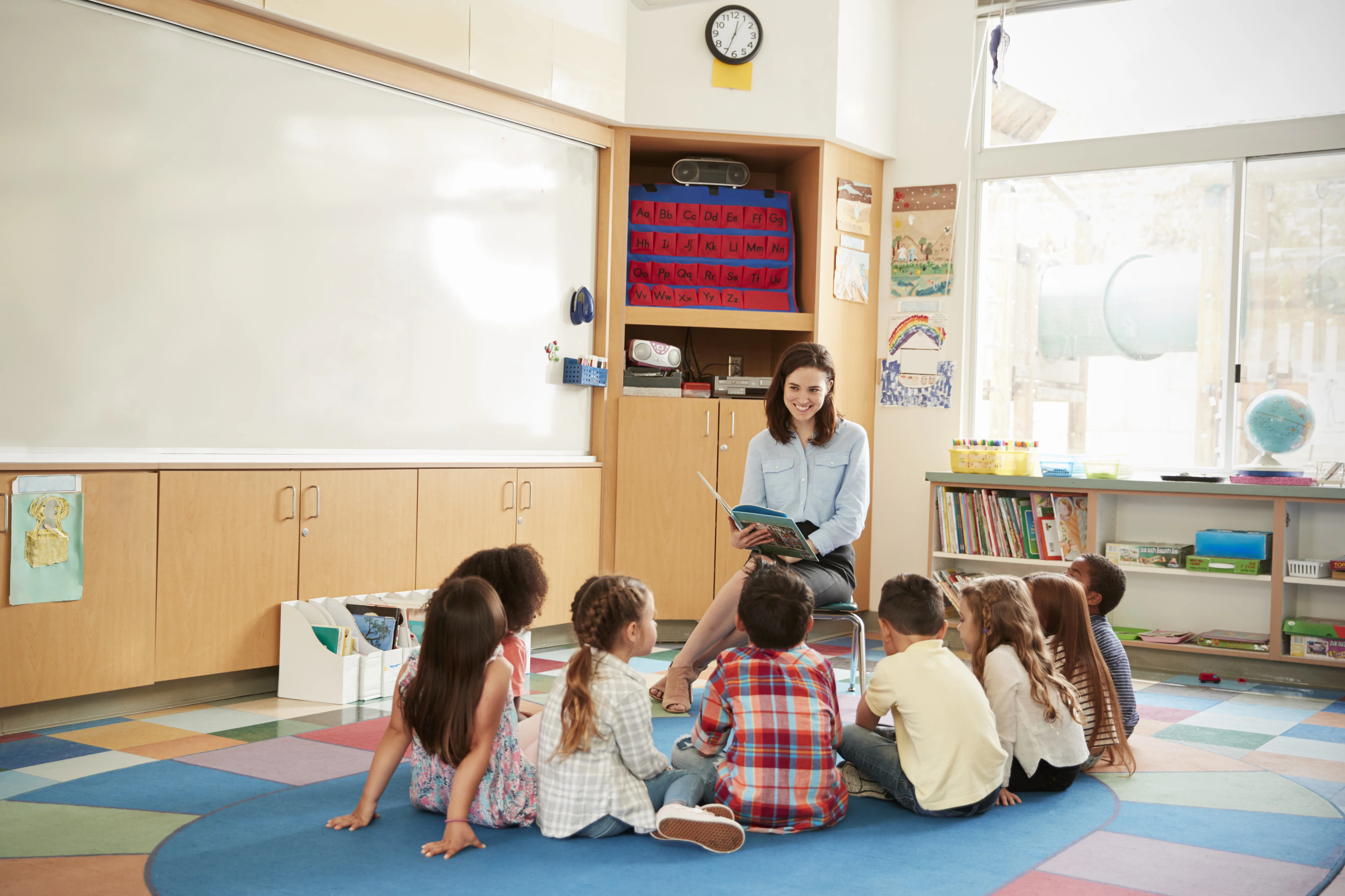
At Spanish Horizons Academy, a typical day begins with a morning academic block conducted entirely in Spanish. During this time, students work through core subjects — mathematics, Spanish literacy, science, and social studies — all taught by a fluent Spanish-speaking teacher. Lessons are interactive and hands-on. A first grader might count manipulatives while practicing number words in Spanish. A third grader might conduct a science experiment and record observations in a Spanish-language journal.
The English Language Arts block, which makes up roughly 20% of the instructional day, is dedicated to building strong reading, writing, and comprehension skills in English. This ensures students develop grade-level English proficiency alongside their growing Spanish abilities.
What truly sets immersion schools apart is how language extends beyond core academics. Cultural enrichment activities — cooking traditional recipes, learning Latin American folk songs, practicing regional dances, creating art inspired by Spanish-speaking countries — are all conducted in Spanish. These experiences create a language-rich environment where Spanish is not just a subject to study but a living tool for exploration, creativity, and connection.
By the end of each day, students have spent the vast majority of their time hearing, speaking, reading, and writing in Spanish — not because they were forced to memorize anything, but because they were too engaged in learning to notice they were doing it in another language.
Benefits of Spanish Immersion for Children
The benefits of Spanish immersion education are well documented and extend across cognitive, academic, linguistic, cultural, and career dimensions. Here is what the research tells us.
Cognitive advantages are among the most compelling reasons families choose immersion. Studies show that bilingual children develop stronger executive function — the set of mental skills that includes working memory, flexible thinking, and self-control. Managing two languages requires the brain to constantly prioritize, switch, and monitor, which strengthens attention and problem-solving abilities. These cognitive gains show up not just in language tasks but across all areas of learning.
Academic performance in immersion students consistently matches or exceeds that of their monolingual peers. A landmark study by Thomas and Collier (2002) followed more than 200,000 students across multiple school districts and found that children in well-implemented immersion programs outperformed their peers on standardized tests in English by the time they reached middle school. The Center for Applied Linguistics has echoed these findings, noting that immersion students show no long-term academic disadvantage and frequently demonstrate academic gains attributable to their bilingual education.
Language proficiency is, of course, the most visible benefit. Children who begin immersion in kindergarten and continue through fifth grade typically achieve near-native bilingual fluency. They can read novels, write essays, hold complex conversations, and think critically — all in Spanish. This level of second language acquisition is virtually impossible to achieve through after-school classes or weekend programs alone.
Cultural competence develops naturally in an immersion setting. Students do not just learn about Spanish-speaking cultures from a textbook — they experience traditions, music, literature, history, and values as part of their daily routine. This deep cultural understanding fosters empathy, perspective-taking, and genuine respect for diversity.
Career readiness is an increasingly important consideration. Bilingualism is one of the most marketable skills in today's economy. From healthcare and education to business, law, government, and technology, employers actively seek professionals who can communicate across languages and cultures. Children who graduate from immersion programs carry this advantage for life.
Social-emotional growth rounds out the picture. Immersion students develop a strong sense of identity and belonging in a multicultural world. They learn to navigate different perspectives, communicate across cultural boundaries, and approach unfamiliar situations with curiosity rather than anxiety. These are skills that serve them well beyond the classroom.
"My Child Doesn't Speak Spanish — Can They Still Enroll?"
This is the single most common question parents ask, and the answer is a clear and reassuring yes. Spanish immersion programs are specifically designed for children who do not yet speak Spanish. That is the entire point.
Young children are remarkably adept at acquiring language through immersion. Unlike adults, who tend to learn languages through rules and translation, children absorb language naturally when they are surrounded by it in meaningful contexts. A kindergartener does not need to understand every word their teacher says on the first day. They pick up meaning through visual cues, gestures, facial expressions, repetition, routines, and the context of the activity itself. Within weeks, most children begin responding to instructions in Spanish. Within months, they are producing words and phrases. By the end of kindergarten, the majority of students communicate comfortably in Spanish during classroom activities.
Teachers in immersion schools are trained in strategies that support second language acquisition for beginners. They use pictures, physical movement, songs, and predictable routines to make content accessible even before students understand the language fully. Scaffolding is intentional and constant — teachers meet each child where they are and build from there.
The adjustment period during the first few weeks is normal and expected. Some children may feel uncertain or quiet as they orient themselves in a new linguistic environment. This is a natural part of the process, not a sign that something is wrong. Experienced immersion teachers know how to create a warm, supportive classroom where every child feels safe to take risks and make mistakes.
Spanish Horizons Academy requires no prior Spanish for enrollment. The program is built from the ground up to welcome children who are hearing Spanish for the first time, and the results speak for themselves.
Spanish Immersion vs. Traditional Spanish Classes
Parents sometimes wonder whether an after-school Spanish program or a weekly language class might achieve the same results as immersion. While any exposure to a second language is valuable, the outcomes are dramatically different.
The key factor is time. Language acquisition research consistently shows that the number of hours spent engaged with a language is the strongest predictor of fluency. An immersion school provides roughly 25 to 30 hours per week of target language instruction, compared to just one to three hours in a typical after-school or enrichment program. That difference is not incremental — it is transformational.
Here is a side-by-side comparison:
| Factor | Immersion School | After-School Spanish Class | |---|---|---| | Hours per week | 25-30 hours | 1-3 hours | | Language method | Content-based instruction | Grammar and vocabulary drills | | Fluency outcome | Near-native bilingual proficiency | Basic conversational ability | | Academic content | Full grade-level curriculum | Language skills only | | Cultural depth | Integrated into daily learning | Limited or occasional exposure | | Reading and writing | Full biliteracy development | Minimal or none | | Long-term retention | High (daily reinforcement) | Low without continued practice |
This does not mean after-school programs are without value. They can be a wonderful supplement or a starting point for families exploring bilingualism. But if the goal is true fluency — the ability to think, learn, and communicate at a high level in Spanish — immersion is the most effective path available.
How to Choose the Right Spanish Immersion School
Not all immersion schools are the same, and finding the right fit for your child matters. Here are the key factors to evaluate as you compare options in the Hillsboro, Beaverton, and greater Portland metro area — or anywhere else.
- Immersion model: Understand whether the school uses an 80/20, 90/10, or 50/50 model and how that aligns with your priorities. An 80/20 immersion model, like the one at Spanish Horizons Academy, ensures deep Spanish exposure while maintaining dedicated English Language Arts instruction from the start.
- Teacher qualifications: Look for schools where teachers are not only fluent in Spanish but also trained in immersion pedagogy and second language acquisition strategies. Native or near-native proficiency matters, but so does knowing how to teach content through a second language effectively.
- Class size: Smaller class sizes mean more individualized attention, more opportunities for each child to speak and be heard, and stronger relationships between teachers and families. Spanish Horizons Academy keeps class sizes between 12 and 16 students per grade — intentionally small to maximize language interaction and academic support.
- Curriculum framework: Ask about the academic framework the school uses. Some immersion schools follow Montessori principles, others use project-based learning, and others adopt structured curriculum models. Spanish Horizons Academy uses Expeditionary Learning, an approach that emphasizes deep investigation, real-world connections, critical thinking, and student-driven inquiry — all conducted in Spanish.
- Track record and parent community: Talk to current families. Visit the school. Ask about student outcomes, teacher retention, and the strength of the parent community. A strong immersion school is not just a place where children learn Spanish — it is a community that supports bilingual families at every step.
- Accessibility and values: Consider whether the school welcomes children with no prior Spanish experience, whether it reflects the cultural diversity of the Spanish-speaking world, and whether its values align with your own.
Choosing an immersion school is one of the most impactful decisions you can make for your child's education. Take your time, ask questions, and trust your instincts.